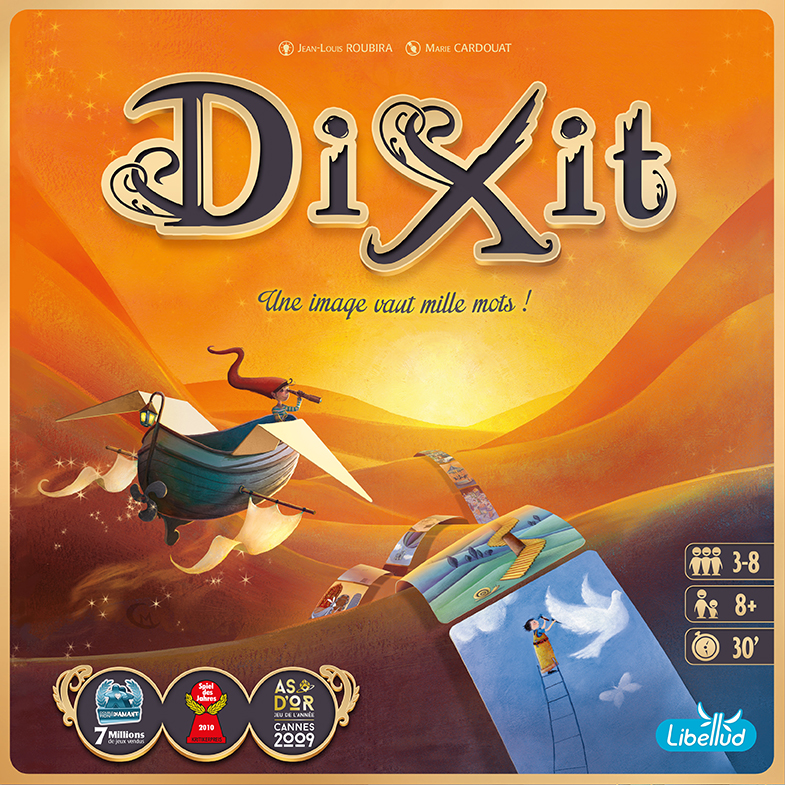
Libellud • 2008
Each player holds a hand of surreal, beautifully illustrated cards — dreamlike images that could mean just about anything. On your turn, you pick a card, say a clue (a word, phrase, sound, song lyric, anything), and place it face down. Everyone else picks a card from their own hand that could also fit your clue, and adds it face down. All cards are shuffled and revealed. Then everyone votes on which one they think is yours. The scoring is the clever part: if everyone guesses correctly, you were too obvious and you score nothing. If nobody guesses correctly, you were too obscure and you also score nothing. You need to land somewhere in between — cryptic enough that some people miss it, clear enough that some people get it. This creates an interesting dynamic where you're calibrating your clue to the people at the table. Your best friend might catch an obscure reference that a stranger wouldn't. The game rewards knowing your audience. The art does most of the heavy lifting. The cards are from illustrator Marie Cardouat and they're genuinely gorgeous — mysterious, symbolic, and open to interpretation. People often pause just to appreciate them. Plays 3-6, best at 5-6 where the vote spread is most interesting. At 3, it's too easy to narrow down. Games last about 30 minutes. Several expansions add more card sets if the originals get overly familiar.
Board Game Specialists & Group Dynamics Researchers
Tested and evaluated across real group game nights. We specialize in group playability, player count scaling, rule clarity, and downtime reduction for gatherings of 2 to 12+ players.
Explore our group game finder, strategy guides, and game reviews.
Answer a few quick questions and get a direct recommendation.
Find the right gameGames with similar group dynamics, time commitment, and player counts.
Getting knocked out ten minutes into a two-hour game while your friends keep playing is miserable. These games eliminate early knockouts entirely so everyone stays in until the final score is tallied.
Christmas game nights include grandparents, kids, competitive uncles, and people who think board games are boring. These are the games that survive that combination.
A family reunion game night needs to work across three generations, zero shared gaming experience, and wildly different tolerances for competition. Here's what survives the room.
Every group has someone who backs away the second a cardboard box appears. These games don’t look like board games, don’t need rules explanations, and pull in everyone at the table.