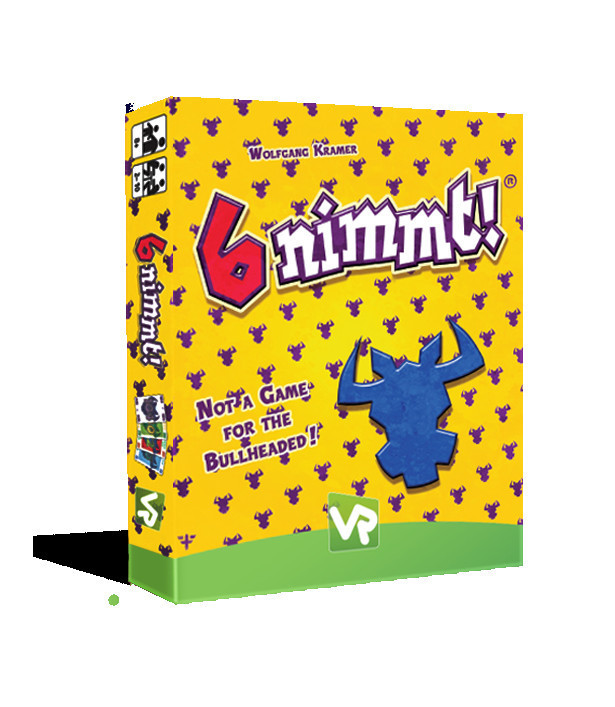
Amigo • 1994
Everyone simultaneously picks a card from their hand and reveals it. Then, in ascending order, each card gets placed at the end of one of four rows on the table. Cards must go in the row where the last card is closest to (but lower than) the played card. If your card becomes the sixth in a row, you take the first five cards (and their penalty points). If your card is lower than every row's last card, you take the row of your choice. The penalty comes from bull heads printed on each card — most cards have 1, but some have 2, 3, 5, or even 7. Low total bull heads wins. The strategy is about reading the rows and predicting what others will play. With 4 players, you can often calculate the safe options. With 10 players, it's closer to chaos — multiple people play similar numbers and rows fill up unpredictably. It's been in print since 1994. The rules fit on a single card. A game takes 20-30 minutes. The components are just 104 numbered cards. It costs almost nothing and fits in a pocket. Plays 2-10. The sweet spot is 5-6 where there's enough unpredictability to be exciting but enough control to reward smart play. At 8-10, it becomes a loud, reactive experience where groaning at bad reveals is half the fun.
Board Game Specialists & Group Dynamics Researchers
Tested and evaluated across real group game nights. We specialize in group playability, player count scaling, rule clarity, and downtime reduction for gatherings of 2 to 12+ players.
Explore our group game finder, strategy guides, and game reviews.
Answer a few quick questions and get a direct recommendation.
Find the right gameGames with similar group dynamics, time commitment, and player counts.
Cramped wooden tables, sticky surfaces, and loud noise destroy most board games. These spill-resistant, fast-teaching titles thrive in high-energy pub settings.
Large groups need different games from regular game nights. Here's what actually works when you have 6 or more people and why most popular games quietly fail at this count.
Most games break at 10. These are the ones built for it — or clever enough to handle it without slowing down.
Waiting for dinner, between heavier games, or just looking to fill 15 minutes with a big group. These games are designed for exactly this situation.
Sometimes you don't know if 4 people are showing up or 14. These games handle the uncertainty because they were designed to ignore player limits entirely.
Fast, high-energy games for 6 to 12+ players that wrap up in under 30 minutes. Perfect for starting the night or playing while dinner is cooking.